Saltar al contenido principal

🇺🇸 US Dispensaries Only

Metrc Reporting on Autopilot — Your Dispensary Stays Compliant Without the Paperwork

In most US states, every cannabis sale has to be reported to Metrc. DabDash does that for you automatically — every order, every package, every adjustment. Your drivers keep moving. Your license stays clean.

Metrc Certified Partner 3-year audit recordNo duplicate reports
The Basics

What Metrc Is, and Why Your State Requires It

Metrc is the government system that tracks cannabis from the grow to the sale. Most US states use it. Think of it as a compliance ledger your state regulator watches in real time — every gram of cannabis that moves has to be accounted for in Metrc, from when it was harvested all the way through to when it lands in a customer's hands.

If you hold a cannabis retail license in a Metrc state, you have three obligations: every product you carry has to be tagged with a Metrc package label, every sale to a customer has to be reported to Metrc, and your inventory has to match Metrc's records. These aren't optional — they're license conditions. Missing a report or getting a quantity wrong is a compliance violation, and regulators fine, suspend, or pull licenses for it.

The question isn't whether you use Metrc — you have to. The real question is who does the reporting. Your staff doing it by hand, or your software doing it automatically while your staff focuses on customers?

Some operators log into the Metrc website and type in every sale themselves. That works if you're doing a handful of orders a day, but it doesn't scale — and manual entry means human mistakes that become compliance problems down the line. The better path is connecting your software directly to Metrc so reporting happens behind the scenes without anyone having to touch it.

That's what DabDash does. Every time an order goes out for delivery, the compliance report goes to Metrc automatically. No extra steps for you, no manual entry for your staff, no gaps in your compliance record.

What's at Stake

What Happens When Metrc Reporting Goes Wrong

Regulators take Metrc seriously. Your state posts enforcement actions publicly, and the pattern is always the same: one missed receipt gets a warning, two gets a fine, and three puts your license under review. The state doesn't distinguish between an honest mistake and neglect — the data either matches or it doesn't.

A busy delivery operation doing 200 to 300 orders a day can easily fall behind on manual Metrc entry. A few missed receipts here, a quantity typo there — it adds up fast. By the time you catch it, you're looking at a compliance gap that takes days to clean up and still shows up on your compliance record.

Doing it by hand is also a real staffing cost. Operators who manage their own Metrc entry can spend ten to fifteen hours a week on it — and that's when nothing goes wrong. When Metrc rejects a receipt for a data mismatch and you have to figure out why, the real cost shows up.

With a proper software integration, the receipt is created the moment your driver heads out. The package label, the quantity, the unit of measure — all pulled from your product setup, no typing required. If Metrc ever asks for proof that a specific order was reported on a specific day, the record is right there. This is what DabDash gives you.

When you're picking delivery software, Metrc support isn't a nice-to-have. It's a core part of whether the platform actually works for a licensed US operator. A beautiful storefront that leaves Metrc as your problem doubles your workload.

How It Works

How DabDash Handles Metrc Behind the Scenes

When your driver marks an order as out for delivery, DabDash queues the compliance report in the background. Your customer gets their confirmation, your driver leaves — nothing slows down. The report goes to Metrc within the minute, handled completely automatically.

If Metrc ever has a hiccup and the first attempt doesn't go through, DabDash keeps trying automatically — minutes apart at first, then with longer gaps if needed. Your order is never in limbo. The moment Metrc confirms the receipt, we mark it done on our end.

We also make sure the same sale is never reported twice. Each report carries your DabDash order number as a unique identifier. Before retrying anything, we check whether Metrc already has it — if it does, we mark it complete and move on. No duplicates, no overstated sales in your compliance record.

Every API call we make to Metrc — and every response we get back — is kept on file for three years. If your state regulator asks for proof that a specific order was reported on a specific date, we can produce it. We've done this for vendors going through state audits.

Each state has slightly different rules — what fields are required, when the receipt has to be finalized, whether medical patient IDs need to be included. DabDash handles all of that automatically based on where your store is located. You don't have to know the difference between California's rules and New York's rules. We do.

metrc-integration.section_3_p6

See It In Action

What the Metrc Setup Looks Like

Here's the actual Metrc setup inside DabDash — from connecting your API key to linking products and checking compliance status on individual orders.

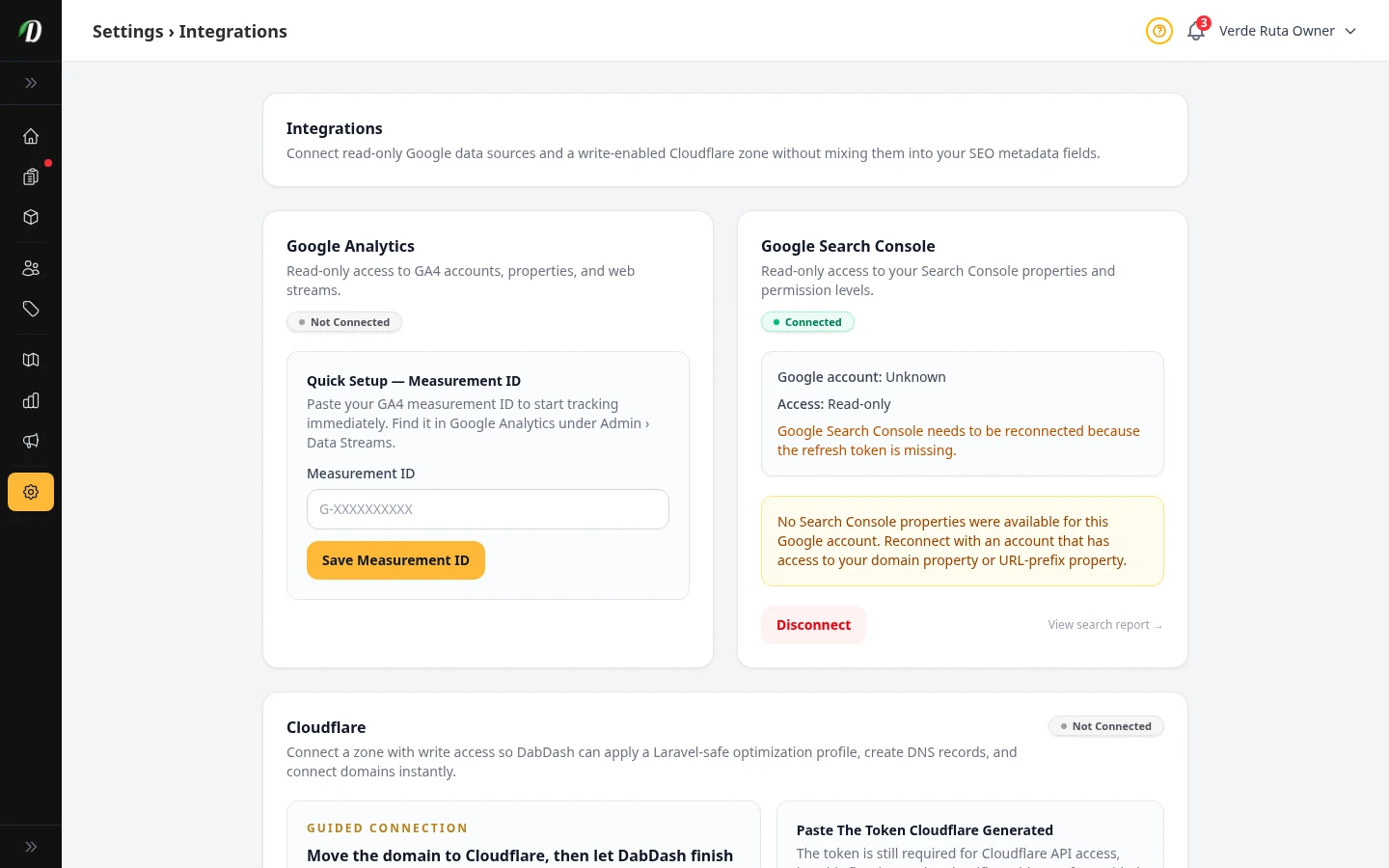
DabDash integrations overview showing Metrc connection option

The integrations page — where you connect your Metrc API key

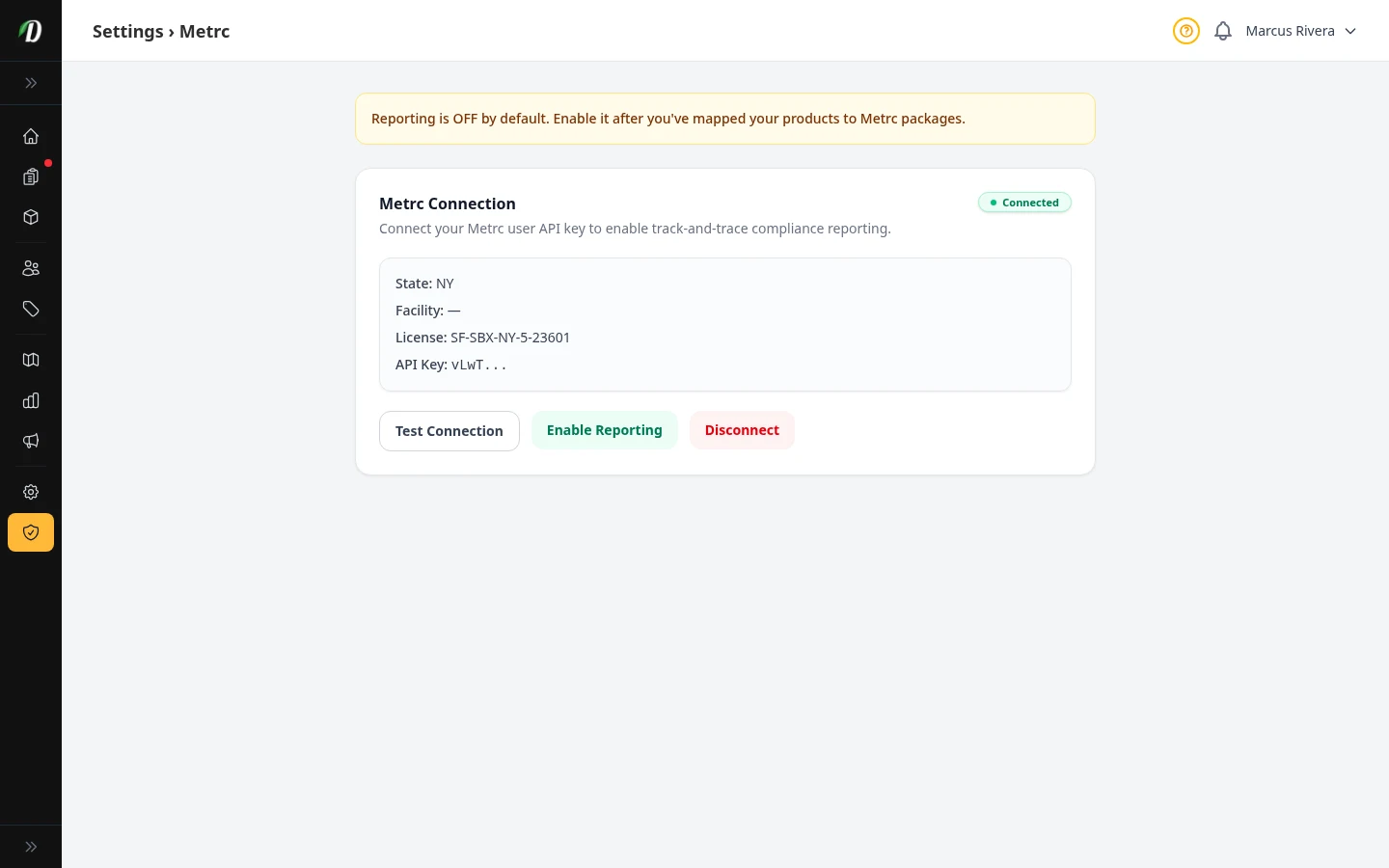
DabDash Metrc settings page with API key connection fields

Your Metrc settings — paste in your state-issued API key and you're connected

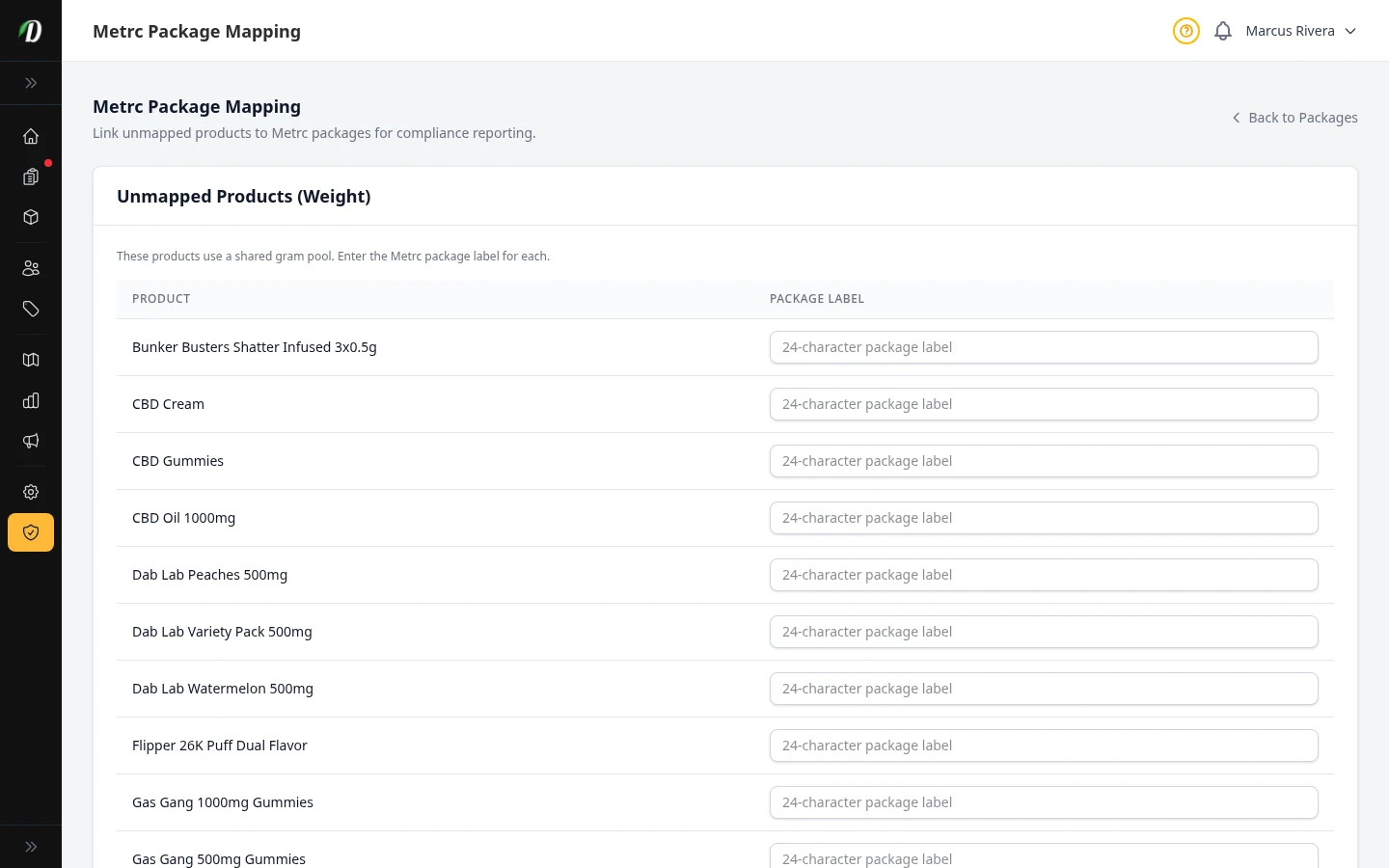
DabDash product mapping screen linking products to Metrc package tags

Product mapping — link each product to its Metrc package tag once, then forget about it

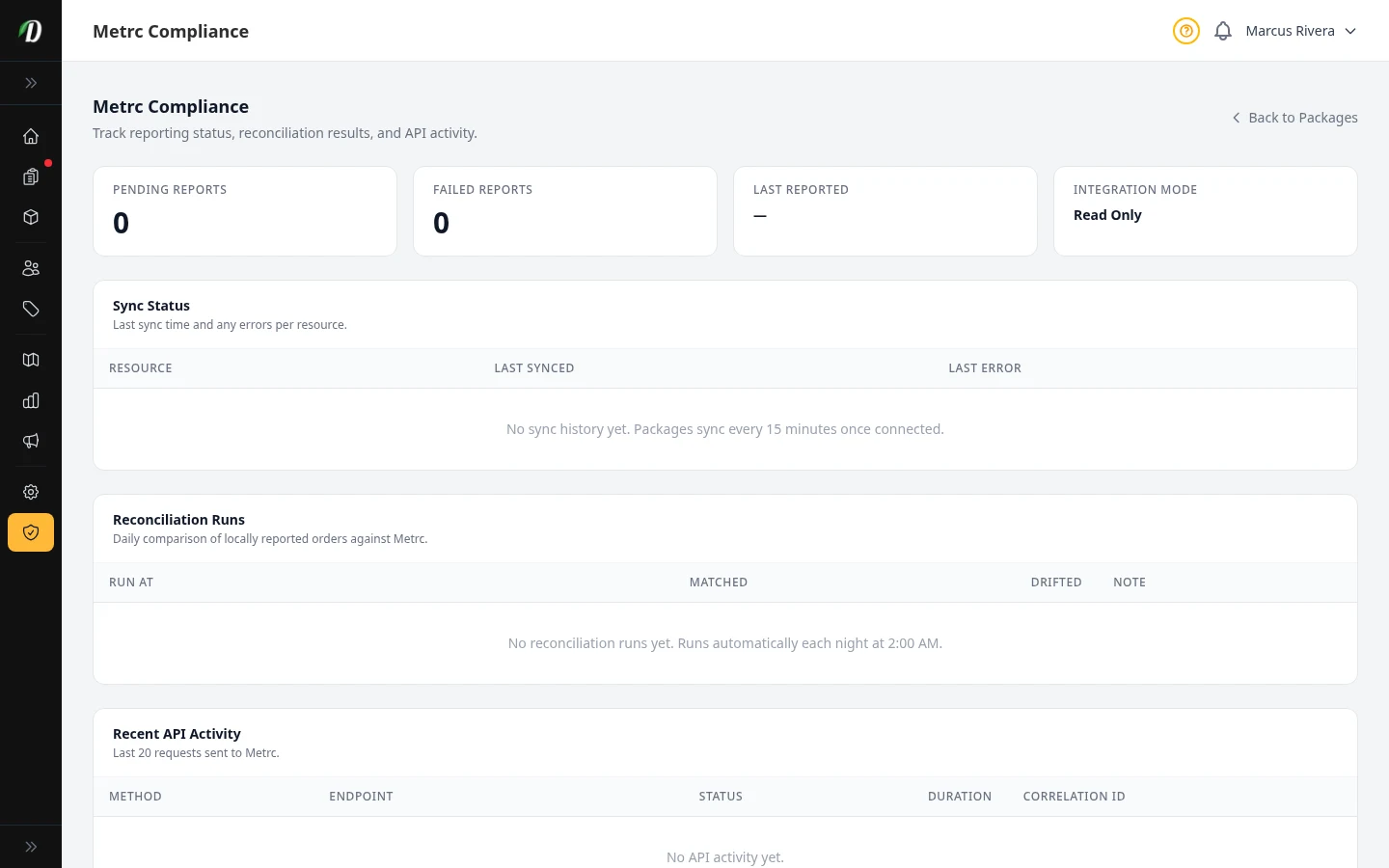
DabDash order compliance panel showing Metrc receipt status

The compliance panel on each order — shows whether the receipt was sent and when

What Gets Reported

What DabDash Reports to Metrc for You

A full Metrc connection isn't just about sales receipts — there's a lot going on in both directions. Here's everything DabDash handles automatically:

We Report to Metrc

These happen automatically every time:

  • Sales receipts — every item in every order, with the right package label, quantity, and customer type.
  • Cancelled orders — if a customer cancels or you issue a refund, the receipt is voided in Metrc too.
  • Inventory adjustments — small corrections for breakage, samples, or testing get reported with the right reason code.
  • Package finishing — when a package is fully used up, we tell Metrc so it's removed from your active inventory.

We Pull from Metrc

These sync into your store automatically:

  • Your active packages — what you actually have on hand, refreshed every 15 minutes. Used when you link products to Metrc.
  • Your registered items — your Metrc item catalog, refreshed hourly.
  • Your employees — for states that require the reporting employee's license number on the receipt, synced daily.
  • Strains — for states that need genetic-level reporting, synced daily.

All of these connections run on their own schedule in the background. If your store was offline overnight, the next sync picks up exactly where it left off — nothing is skipped.

For products where one package backs multiple sizes — an eighth, a quarter, a half all drawing from the same bag — DabDash calculates the gram deduction correctly based on what was actually sold. For pre-rolls, edibles, and other unit-counted items, each variation links to its own package. The setup happens once on your product page, and after that it just works.

State Coverage

Which States Are Live (and What's Coming)

Each state requires its own approval process, testing period, and go-live. We're rolling out one state at a time and only launching once we've confirmed everything works cleanly in production. Here's where things stand through end of 2026.

Live now Launching soon Planned
  1. Live Now (April 2026)

    • CACalifornia

      Full delivery reporting — receipt confirmed when the driver heads out

    • NYNew York

      Adult-use and medical, OCM compliant

  2. Late May 2026

    • MIMichigan

      Pilot done — production launch end of May

  3. By End of June 2026

    • COColorado

      Sales reported on a different cadence — handled automatically

    • MAMassachusetts

      CCC compliant

  4. July – September 2026

    • NJ
      New Jersey
    • OH
      Ohio
    • MD
      Maryland
    • NV
      Nevada
    • MO
      Missouri
  5. October – December 2026

    • OR
      Oregon
    • ME
      Maine
    • RI
      Rhode Island
    • MT
      Montana
    • AK
      Alaska
    • AZ
      Arizona
    • LA
      Louisiana
    • MS
      Mississippi
    • WV
      West Virginia
    • SD
      South Dakota
    • DC
      District of Columbia

Each state requires us to sign their API agreement, receive a test API key, complete a compliance worksheet, run a pilot with a real store for two weeks, and only then open it up. We don't announce a state as live until we've seen real orders go through cleanly.

Dates depend on how quickly each state's Metrc team processes our paperwork — that part is out of our hands. If a state takes longer, we'll update the date here. If your state isn't live yet, your full DabDash store still works — only the automatic Metrc reporting is waiting on approval.

See the compliance dashboard in action

Walk through the connection screen, product linking, and the per-order compliance status panel.

Official Certification

We're a Metrc-Certified Software Partner

DabDash is built by Shadow Software LLC, which is a Metrc-certified Third-Party Vendor. That means we've been vetted and approved by Metrc LLC — the company that runs the track-and-trace system — to build software that connects to Metrc on behalf of licensed cannabis retailers.

We passed Metrc's certification exam with a perfect score on April 21, 2026. The certificate is on file. This certification is what gives us access to the production API keys for each state — without it, we can't connect at all.

Certification isn't a one-time thing. Metrc requires us to recertify annually, stay current with each state's compliance bulletins, and follow strict rules around how we send and receive data. Every Metrc-related change we make goes through a compliance review before it goes live.

For you, this means: when a state auditor reviews your Metrc records, the software partner listed is Shadow Software LLC — a name that's on file with Metrc as a credentialed vendor. That record is what makes your audit trail hold up.

What We've Already Figured Out

Problems We've Solved So You Don't Hit Them

A few of the things that go wrong with cheaper or less experienced Metrc integrations — and how DabDash handles each one:

Wrong units on the receipt
A common problem: a product tracked by the gram gets linked to a Metrc package that's counted by the unit, or vice versa. Metrc rejects the receipt and nothing gets reported. DabDash blocks this when you're setting up your products — if the units don't match, you get a clear error message before you can save. The mismatch never makes it to your compliance record.
Same sale reported twice
A shaky internet connection can cause the same receipt to be submitted more than once. Metrc accepts both, leaving your compliance record showing more sales than you actually made. DabDash checks before every retry whether Metrc already has the receipt. If it does, we skip it. The same sale is never counted twice.
Report silently dropped when Metrc is down
Some integrations report to Metrc in the same moment as the sale. If Metrc is briefly unreachable, the report is lost — and nobody notices until a regulator asks. DabDash queues every report separately from the sale itself. The order goes through even if Metrc is slow. The queued report keeps retrying until it goes through.
Accidental reports before setup is complete
If reporting turns on before all your products are linked to Metrc packages, you end up submitting receipts with blank or wrong package information. DabDash keeps reporting off by default until every active product is properly linked. Turning it on is a deliberate step — and the moment you flip that switch is noted in your audit record.
Getting rate-limited by Metrc
Metrc limits how quickly software can send requests. Stores that first connect often need to pull a large amount of data, and a naive sync will immediately hit those limits and stall. DabDash paces the initial data pull carefully and keeps the daily sync within Metrc's rate limits — so the regular cadence never gets disrupted by a one-time catch-up.
No proof when the auditor calls
When a regulator asks for proof that a specific order was reported on a specific date, most software vendors make you dig through logs to reconstruct the answer. DabDash keeps a full record of every Metrc exchange — what was sent, what came back, exactly when — for three years. Getting the proof for any order takes seconds.
Running Multiple Stores

Multiple States, One Platform

If you operate in more than one state, running a different point-of-sale system in each location might seem like the path of least resistance. In practice it means three vendor relationships, three audit trails in different formats, and three compliance records to manage when something goes wrong.

DabDash handles this differently. Each of your licensed locations connects to its own state's Metrc system through the same platform. The state-specific rules — what fields are required, how sales are finalized, whether medical patient IDs are needed — are built into DabDash per state. When you add a location in a new state, the right rules load automatically.

In practice, running stores in California, New York, and Michigan means the same dashboard, the same compliance record format, and one vendor relationship across all three. Adding a fourth state is a settings change, not a new software project.

Every report, across every location, is kept for three years and searchable by date, order, or store. When an audit spans multiple facilities, you're not chasing down records from different systems — everything is in one place.

FAQ

Common Questions

What is Metrc integration?

Metrc integration means your cannabis delivery software automatically reports your sales to the government track-and-trace system — Metrc — on your behalf. Instead of logging into the Metrc website and entering receipts by hand, DabDash does it the moment each order goes out for delivery. Every sale, every package, every void gets reported automatically.

Which US states does DabDash currently support?

As of April 2026, DabDash is live with Metrc in California and New York. Michigan launches in late May 2026. Colorado, Massachusetts, New Jersey, Ohio, Maryland, Nevada, Missouri, Oregon, Maine, Rhode Island, Montana, Alaska, Arizona, Louisiana, Mississippi, West Virginia, South Dakota, and Washington DC are all scheduled before the end of 2026.

Does DabDash report sales to Metrc automatically?

Yes — completely. When your driver marks an order as out for delivery, DabDash queues the report and sends it to Metrc within the minute. If the first attempt doesn't go through, it keeps retrying automatically. You don't do anything — the order gets reported whether you think about it or not.

Is DabDash officially certified by Metrc?

Yes. Shadow Software LLC — the company behind DabDash — is a Metrc-certified Third-Party Vendor. We passed Metrc's certification with a perfect score in April 2026. That certification is what gives us access to Metrc's production API in each state.

What if the same sale gets reported twice?

It won't. DabDash checks Metrc before retrying any report to make sure it isn't already there. Each receipt carries your DabDash order number as a unique identifier. If Metrc already has it, we skip the retry. The same sale can't be double-reported.

What happens to my orders if Metrc is down?

Your store keeps running normally. DabDash queues every Metrc report separately from the sale — your customer places the order, your driver goes out, everything proceeds as usual. The compliance report keeps retrying in the background until Metrc comes back up. Customer checkout is never blocked.

How long does DabDash keep my Metrc records?

Three years. Every report we send to Metrc, and every response we receive, is on file for three full years. If a state auditor asks for proof that a specific order was reported on a specific date, we can pull it up in seconds.

Do I have to link every product to a Metrc package?

Yes — that's the one setup step you do yourself. Each product in DabDash has a Metrc section where you link it to the right package tag. DabDash catches unit mismatches when you save so you can't accidentally link the wrong type. Once every product is linked, you turn on reporting and the rest is automatic.

What about accessories, lighters, and non-cannabis items?

Non-cannabis items don't go to Metrc — only cannabis packages do. You mark those items as exempt in DabDash and they're left out of compliance reports automatically. An order with only accessories doesn't generate a Metrc receipt at all.

I operate in multiple US states. Can DabDash handle that?

Yes. Each of your licensed locations is a separate store in DabDash, connected to its own state's Metrc system. The state-specific rules load automatically based on where your store is. You get the same dashboard and compliance record format across all your locations — one platform for everything.

Does Metrc integration work outside the US?

No — Metrc is a US-only system. DabDash operates in many other cannabis markets worldwide (Canada, Germany, Thailand, Spain, and others), but Metrc integration is only relevant for US-licensed retailers in states that require it. Vendors outside the US see no Metrc settings at all.

Does the Metrc integration cost extra?

No. Metrc integration is included in every DabDash plan at no extra charge. No per-receipt fees, no compliance add-on, no hidden costs. The certification, the testing, and the ongoing state bulletins are all on us.

Ready to stop worrying about Metrc?

Start your free 14-day trial — no credit card required. Metrc reporting included on every plan.

Get Started Free